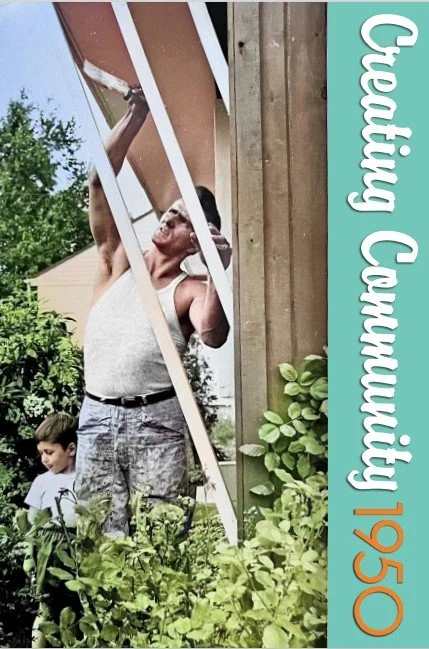
Creating Community: 1950
The Hickory Hill Experiment
Here is an origin story not unlike that of our first Dutch settlers. When a group of WWII Vets found themselves bunkered at Shanks Village - they rallied together to find a way to stay here. Not unlike the Salyer or DePew families that assisted one another in constructing their Dutch sandstone houses - the residents of what came to be called Hickory Hill banded together to make Orangetown their home.
“In pioneer days, a man who needed a house just laid up for log walls and got the neighbors to help him put up a roof over them. The man who had all the skills needed to build a house today is rare indeed. In 1946 most of the present Hickory Hill owners were living in a student-veteran housing project near New York called Shanks Village. They knew that they couldn’t go on living there indefinitely and began thinking about houses of their own. A serious minded, scholastic crowd - several of them are Ph.D.’s in subjects such as botany, chemistry, and anthropology - their first step was to form a study group. An architectural student led the study of types of houses and developed a questionnaire on preferences and special requirements; a lawyer spearheaded an investigation of way and means of organizing and financing a housing cooperative; and engineer led the attack on such problems as heating. The sute that they chose consisted of 32 acres in Tappan, New York. It was part of a hillside farm over which the Redcoats and Colonials marched in the Revolution. They laid it out over 32 lots, averaging a little less than an acre, and set aside the balance - about two acres, for community development. Then, in the spring of 1950 they went to work.”
- Arthur Bartlett
POPULAR SCIENCE, April 1952
04/21/2024-11/24/2024
Previously on view at the Isaac DePew House